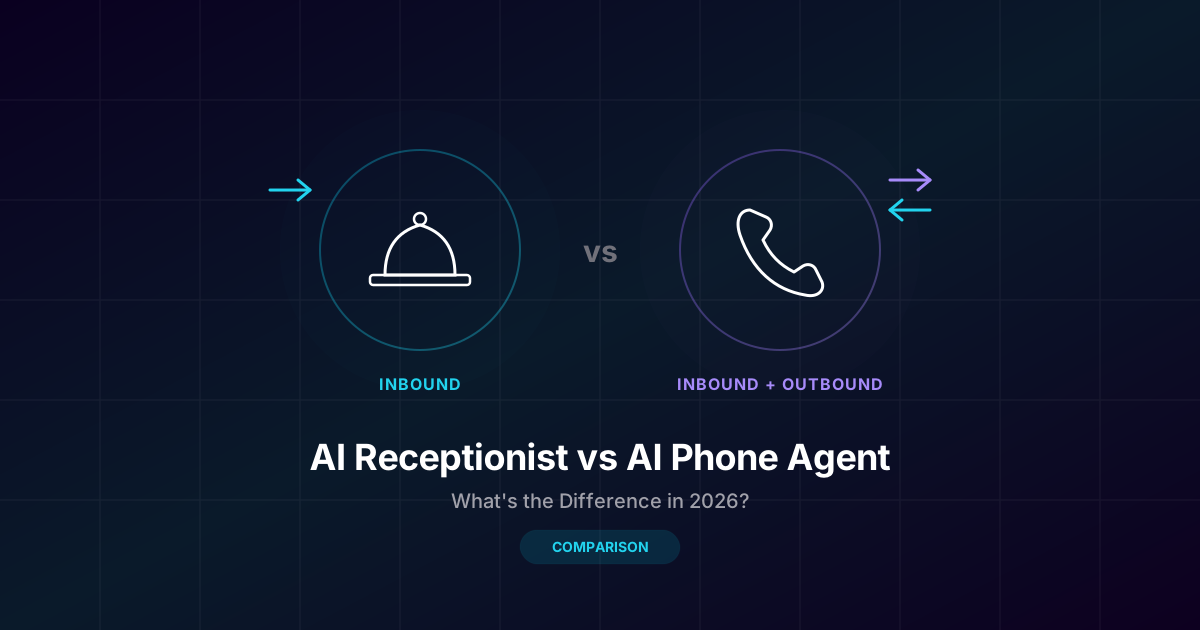
An AI receptionist answers incoming business calls and handles front-desk work: answering questions, taking messages, booking appointments, qualifying callers and transferring calls. An AI phone agent can do all of that and also make outbound calls. It follows up with leads, confirms appointments, runs campaigns, collects information, updates CRM systems and triggers other business workflows.
The two terms overlap. Every AI receptionist can be considered an AI phone agent, but not every AI phone agent is only a receptionist, and many modern platforms now combine both capabilities in one system.
Both terms come up constantly once a business starts looking for something to replace voicemail, complicated IVR menus, manual follow-up calls or an overloaded front desk. Below is what each one does, where they differ, and how to pick between them.
What Is an AI Receptionist?
An AI receptionist is a conversational voice system that answers incoming phone calls for a business. Callers don't have to work through a "Press 1 for sales" menu or leave a voicemail. They just say what they need.
Say someone calls and asks, "I'd like to book an appointment for Friday afternoon." The AI understands the request, checks the scheduling system, collects the caller's information, offers available times, confirms the appointment and records the result.
A capable AI virtual receptionist can also answer frequently asked questions, capture leads, take messages, screen callers, identify why someone is calling, route calls to employees, handle after-hours inquiries, and save transcripts and summaries. That is most useful for businesses where an unanswered call can mean a lost customer.
What Is an AI Phone Agent?
An AI phone agent uses the same conversational technology outside the front desk. It can receive phone calls and make them.
An inbound AI phone agent might answer support questions or route a customer to the correct department. An outbound AI phone agent might call a new website lead seconds after they submit a form, contact customers about upcoming appointments, follow up on quotations, qualify prospects, collect survey responses or reconnect with old leads. In practice it works more like a digital phone employee than a traditional answering service.
Modern systems also connect calls to calendars, CRM systems, databases, APIs, property-management systems and internal business tools. The conversation is one step in a larger workflow, and most of the value comes from what the agent does during and after the call.
Ready to try AI voice agents?
Deploy in minutes with 119+ pre-built templates. No code required.
AI Receptionist vs AI Phone Agent
| Capability | AI Receptionist | AI Phone Agent |
|---|---|---|
| Answer inbound calls | Yes | Yes |
| Make outbound calls | Usually limited | Yes |
| Answer FAQs | Yes | Yes |
| Take messages | Yes | Yes |
| Route calls | Yes | Yes |
| Book appointments | Yes | Yes |
| Qualify leads | Yes | Yes |
| Follow up with leads | Limited | Yes |
| Appointment reminder calls | Limited | Yes |
| Outbound campaigns | No/limited | Yes |
| CRM updates | Sometimes | Yes |
| API workflows | Sometimes | Yes |
| Customer support automation | Basic to advanced | Advanced |
| Sales calling | Limited | Yes |
| Inbound + outbound automation | Mainly inbound | Yes |
Which one fits depends less on the technology and more on the job you want the AI to do.
When Should You Use an AI Receptionist?
An AI receptionist makes sense when your biggest problem is answering incoming calls.
Take a dental clinic. Patients call throughout the day about availability, office hours, treatments, appointments, cancellations, directions, insurance and existing bookings, and a human receptionist gets overwhelmed when several of those calls come in at once. An AI calling receptionist answers each one instantly, handles the routine requests, schedules appointments and transfers unusual situations to staff.
The same model works for law firms, hotels, real-estate companies, healthcare practices, restaurants, home-service businesses, automotive businesses and other call-heavy industries. The AI takes the repetitive conversations, which leaves employees free for the ones that need human judgment.
When Should You Use an AI Phone Agent?
An AI phone agent is the better fit when your workflow includes both incoming and outgoing calls.
Picture a potential customer filling out a form to request information. Usually a salesperson notices the lead twenty minutes later, calls, gets no answer, tries again the next day and eventually forgets about it. An AI sales phone agent can place that call automatically, and the workflow becomes:
- The lead submits the form.
- The AI calls the lead.
- It qualifies their interest and answers questions.
- It books a meeting.
- It saves the conversation and updates the CRM.
- It alerts a sales representative.
At that point the phone system is part of your lead qualification process, connected to the rest of the business, and answering the business line is only a small piece of what it does.
AI Phone Answering Service vs Traditional Answering Service
Traditional answering services generally use human operators who answer calls for many businesses. They can work well when callers need human judgment, but their capacity and operating cost scale with staffing.
An AI phone answering service can answer calls around the clock, handle multiple conversations simultaneously, follow predefined business rules and automatically store structured information from every call.
The more useful question for most businesses is which conversations can safely be automated and which should reach a person. A well-designed system has clear escalation rules. If the AI runs into an emergency, a sensitive issue, an unusual request, an angry customer, a high-value opportunity or anything outside its knowledge, it should transfer or escalate the call.
What Should a Modern AI Receptionist Actually Do?
A realistic voice that can't complete the caller's request is just another IVR. What you want to know is whether the AI can turn a conversation into a completed business outcome. A basic phone bot stops at the conversation. A practical AI business agent can run the whole call:
- It answers and works out the caller's intent.
- It checks business information and answers questions.
- It captures the caller's details.
- It books or updates an appointment.
- It transfers the call when necessary.
- It stores the transcript, creates a summary, updates the CRM and triggers any follow-up.
Appointment Booking Is One of the Most Important Use Cases
Appointment scheduling suits voice AI well because much of the conversation follows repeatable rules.
When a caller asks, "Do you have anything available Thursday morning?", an AI appointment booking receptionist can check availability while the caller is still on the phone. More advanced workflows also cover rescheduling, cancellations, confirmations, reminders, intake questions and escalation to a human.
TurboCall, for example, currently combines phone-based appointment workflows with AI reception, inbound and outbound calling, transcripts, CRM updates and analytics.
AI Receptionists for Hotels
Hotel calls cover a lot more than appointment scheduling. Guests ask about room availability, check-in times, cancellation policies, parking, breakfast, pets, late arrival, amenities and existing reservations.
A general AI receptionist can answer the FAQs. A hotel-specific AI receptionist is much more useful once it's connected to the property's systems. It can then potentially understand the guest's request, access permitted reservation or availability information, answer questions, start booking workflows, transfer complex requests and record the interaction.
TurboCall's hotel offering is currently built around hotel voice reception, PMS integrations and multilingual guest communication, with integrations covering systems such as Cloudbeds and OwnerRez. For a hospitality business, that kind of vertical integration can matter more than which AI platform has the most impressive voice demo.
Inbound AI Calling vs Outbound AI Calling
Inbound AI calling starts when the customer calls the business. The system has to identify intent quickly and decide whether to provide information, capture details, complete an action or transfer the call.
Outbound AI calling starts when the business places the call. The agent may already know the customer's name, lead source, appointment information or previous interactions, so it can run workflows such as lead qualification, appointment reminders, follow-ups, customer surveys, booking confirmations and sales outreach.
If you plan to automate several departments, look for an AI calling platform that supports both directions so you aren't running two completely separate systems.
What to Look for in an AI Calling Platform
How human the demo voice sounds tells you very little. Evaluate the complete system: conversation quality, reliability, response speed, inbound and outbound support, call transfer, integrations, appointment booking, CRM synchronization, analytics, transcripts, recordings, multilingual support, workflow customization, concurrency and pricing.
Then test the failure cases. What happens when the caller interrupts or changes their mind? What if they give incomplete information, or an integration becomes unavailable mid-call? Most important of all, how does the AI decide that a human should take over? The answers usually determine whether an AI receptionist works reliably in production.
How TurboCall Approaches AI Phone Automation
TurboCall combines AI receptionist functionality with broader AI phone agent capabilities. Businesses can use it for inbound reception, outbound calling, lead qualification, appointment booking, customer communication and call routing.
The platform supports inbound and outbound workflows, CRM integrations, conversation transcripts, call summaries and human handoff. It comes with 119+ call templates, supports 40+ languages through its available engines, and has sub-400ms response latency.
A business can start with something simple, such as answering missed calls, and later use the same setup for lead qualification, scheduling, reminders or outbound campaigns.
Plans start at $14.99/month for Starter, with Standard at $34.99/month and Pro at $64.99/month. There's also a free tier for trying it out. See the pricing page for what each plan includes.
AI Receptionist or AI Phone Agent: Which One Do You Need?
Choose an AI receptionist when your main objective is handling incoming business calls. Choose an AI phone agent when you want to automate more of your phone operation, particularly when outbound calls, CRM workflows, lead follow-up or campaigns are involved.
For many businesses, though, the choice is becoming unnecessary. We think the better approach is one conversational AI platform that does both jobs. Your front desk might use it as an AI receptionist and your sales team as an AI sales phone agent. Operations might run appointment reminders on it, and customer support might use it for inbound triage. The underlying technology is the same in every case; only the workflow changes.
Turn Every Phone Call Into an Action
A modern AI receptionist can answer the call. An AI phone agent can also understand the request, complete the task, update your systems and trigger whatever needs to happen next.
TurboCall brings both into one AI calling platform for inbound and outbound business communication. You can start with an AI receptionist today, then add appointment booking, lead qualification, customer support and outbound calling as your business grows.
Try TurboCall and make your first AI-powered phone call.